Prologue
The Opening
What follows is the prologue of The Moon's Shadow: Fracture of the Divine. It runs about fifteen hundred words. Read it the way you would read the first pages of a book in a quiet shop.
Before the Breaking
Before the wound, there was the world.
The Seventh Realm, which the Architects of the Old Cosmos had named Erethis: a word that meant, in the language that preceded language, the place where balance learned to love itself. Seven hundred and twelve inhabited surfaces, each one a different answer to the question of what life could become if given enough time and care. Mountains that had learned patience. Seas that had learned restraint. Forests old enough to have developed opinions about the nature of light.
It was not the most complex of the seven hundred and seventy-seven Realms. It was the most beloved.
This distinction matters. Complexity can be built. Love is discovered, or it is not.
The Seventh Realm had been tended for longer than the other Realms had existed. Two Architects, one Maker and one Unmaker, assigned to its coherence before the concept of coherence had been tested against the full violence of what existence actually required. They had been there when Erethis was only a formless charge of potential, a knot of Maker-force and Unmaker-force so perfectly matched that the space between them had begun, slowly, to believe in itself. They watched the first mountains decide to stay. They watched the first seas consider the concept of shore. They were present, which means they did not only watch but were changed by watching, and things that are changed by watching rarely remain only watchers.
This is the first thing that must be understood: they built it together, which means they are inside it, which means the Realm and its makers and its loss are not three separate facts.
They are one fact, told in three registers.
The light in the Seventh Realm had no equivalent in the surviving records. Descriptions exist in the Memory Mosaic, crystallized from the impressions of eleven billion inhabitants across seven hundred and twelve surfaces, and these descriptions agree on the following: it was warm. Not the warmth of temperature. The warmth of being seen.
The light in Erethis had learned, over uncountable ages, to find the exact angle at which any given surface was most itself, and it arrived at that angle each morning with the quiet regularity of a thing that does not question its purpose because its purpose is evident and good.
The sky was amber in the hours before dawn. Not amber like a stone, not amber like a color applied from outside, but amber the way a thing is when it is made of something that has been holding warmth for longer than any observer has existed to notice. The amber was not a phenomenon. It was a consequence. The consequence of two forces, Maker and Unmaker, working in such sustained concert that even the atmosphere had absorbed the nature of their balance.
When they were in harmony, the sky was amber.
This is recorded in the Mosaic. The record is exact. The sky's color was not decorative. It was diagnostic. The inhabitants of Erethis knew this, though most of them knew it the way a body knows how to breathe. Not as a fact held in language. As a fact lived in the chest.
In the last age of Erethis, the amber lasted longer each morning.
Not because the Architects were failing. Because they were not.
What they had built over their time together, across seven hundred and twelve surfaces and the impossible complexity of eleven billion lives and the accumulated weight of what it means to be the keeper of a world, had passed beyond the careful, functional balance their commission required. The Maker-force and the Unmaker-force, which should have remained in productive tension across the formal distance the Sacred Laws specified, had begun to move toward each other with a quality that had no name in the administrative vocabulary of the Celestial order.
They had been watching each other while they built. They had been changed by what they watched. They had reached the threshold beyond which two beings who have spent an eternity learning the same thing by different means can no longer maintain the fiction that what they have made together is only a product and not also a declaration.
The Sacred Laws named this Forged Love.
The Celestial authorities named it a violation.
The sky in Erethis continued to be amber. Longer and longer. The amber was the love made visible in the atmosphere. The inhabitants of eleven billion surfaces did not know why the dawn had grown more generous. They only knew that something had changed in the character of their mornings, and that the change felt, in the chest, the way a thing feels when something far away and necessary is drawing closer.
In the last hours of the last good age, the two Architects stood at the edge of a cliff on the fourth-largest surface of Erethis, where the stone terraces ended and the world's natural depth began.
They were not human. They had never been human, and would not have chosen to be, because the human lifespan is beautiful and brief and insufficient for what they did. What they were, it is not important to name here. What matters is that they had been present since before the first stone of the first building, and that everything below them, across all seven hundred and twelve surfaces, existed in the irreplaceable form it had because of the tension between them.
The Maker stood closer to the cliff's edge. She always wanted to see the most of it. This was not greed. That was how her attention worked, that particular reflex: move toward what you love so you can hold it with your eyes if you cannot hold it any other way. She had always been this way, ever since the first morning of the first surface, long before the sky had learned its amber.
The Unmaker stood slightly behind her, and to her left. He always left her the better view.
This was not deference. This was the precise shape of how he loved: he did not diminish himself for her. He simply redirected his gaze toward whatever she was looking at, so they were seeing it together, from nearly the same angle, at nearly the same moment. Thousands of years of this. The amber sky visible above them, its color the visible product of that posture extended across an eternity.
She said something. Not loudly. The exact words are not the point. What matters is that he turned toward her, and that whatever she said was the kind of thing that can only be said after thousands of years of knowing someone: one of those small, private sentences that would mean nothing overheard by a stranger, but which, inside the acoustics of a long and complicated love, lands with the full weight of everything it is not saying.
He turned toward her.
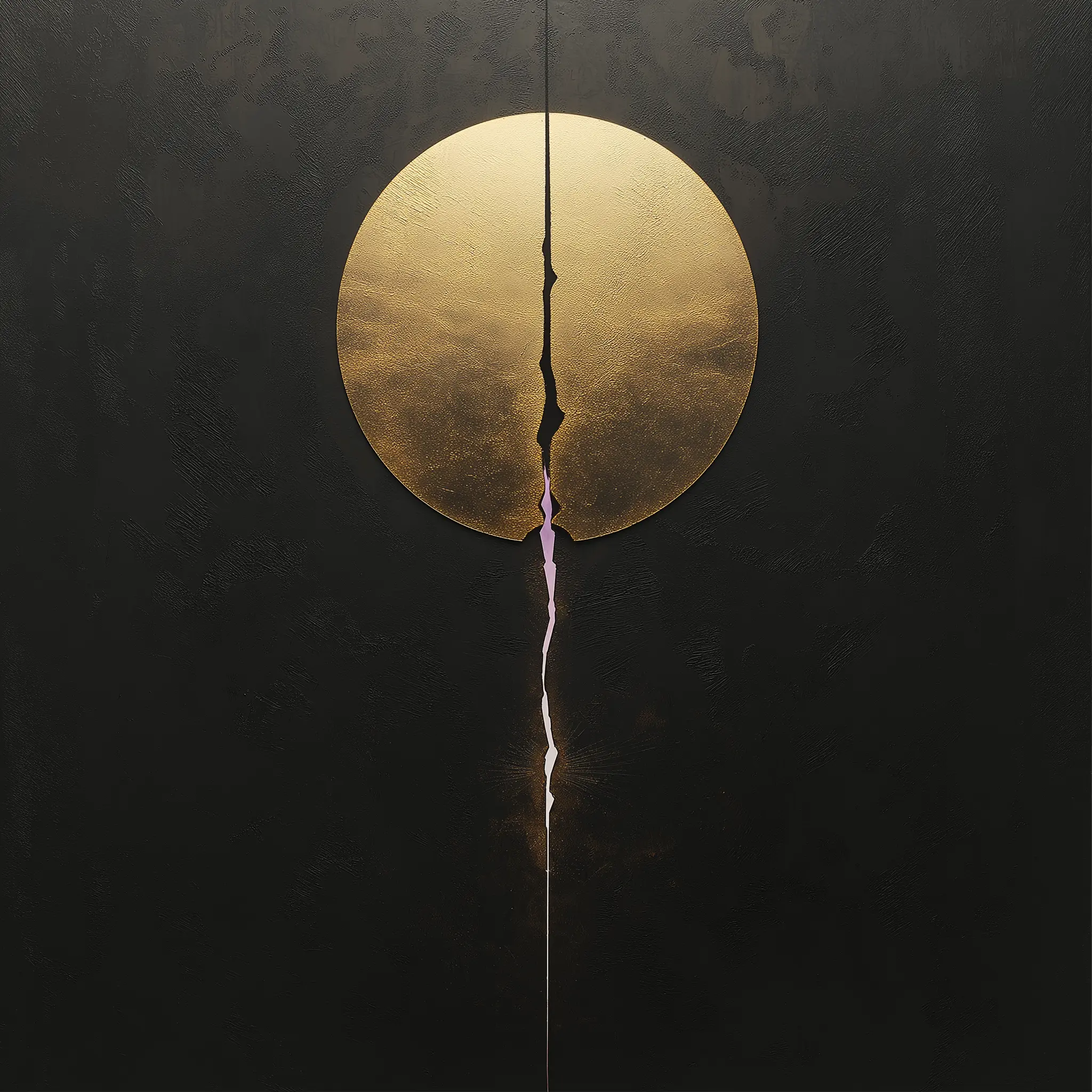
That was when the crack appeared.
The Sundering was not a consequence of the love. It was a consequence of the discovery of the love.
Something moved in the structure of things. The bond between them, which had no name in the administrative vocabulary of the Celestial order, was severed at its root, in the time it takes for the sound of something irreplaceable to travel from the place where it breaks to the place where it is heard.
The Unmaker's hands went still.
He had thirty-one seconds. He knew this the way he knew load distributions and stress fractures and all the mathematics of things that are about to fail: not through calculation but through the body's knowledge, which is faster. He felt the fracture propagating. He felt what would be left. His hands, at his sides, went perfectly still: the discipline that had always been the most expensive thing he maintained, the cost of being a thing that undoes what it touches when it forgets to be careful.
He crossed the distance between them.
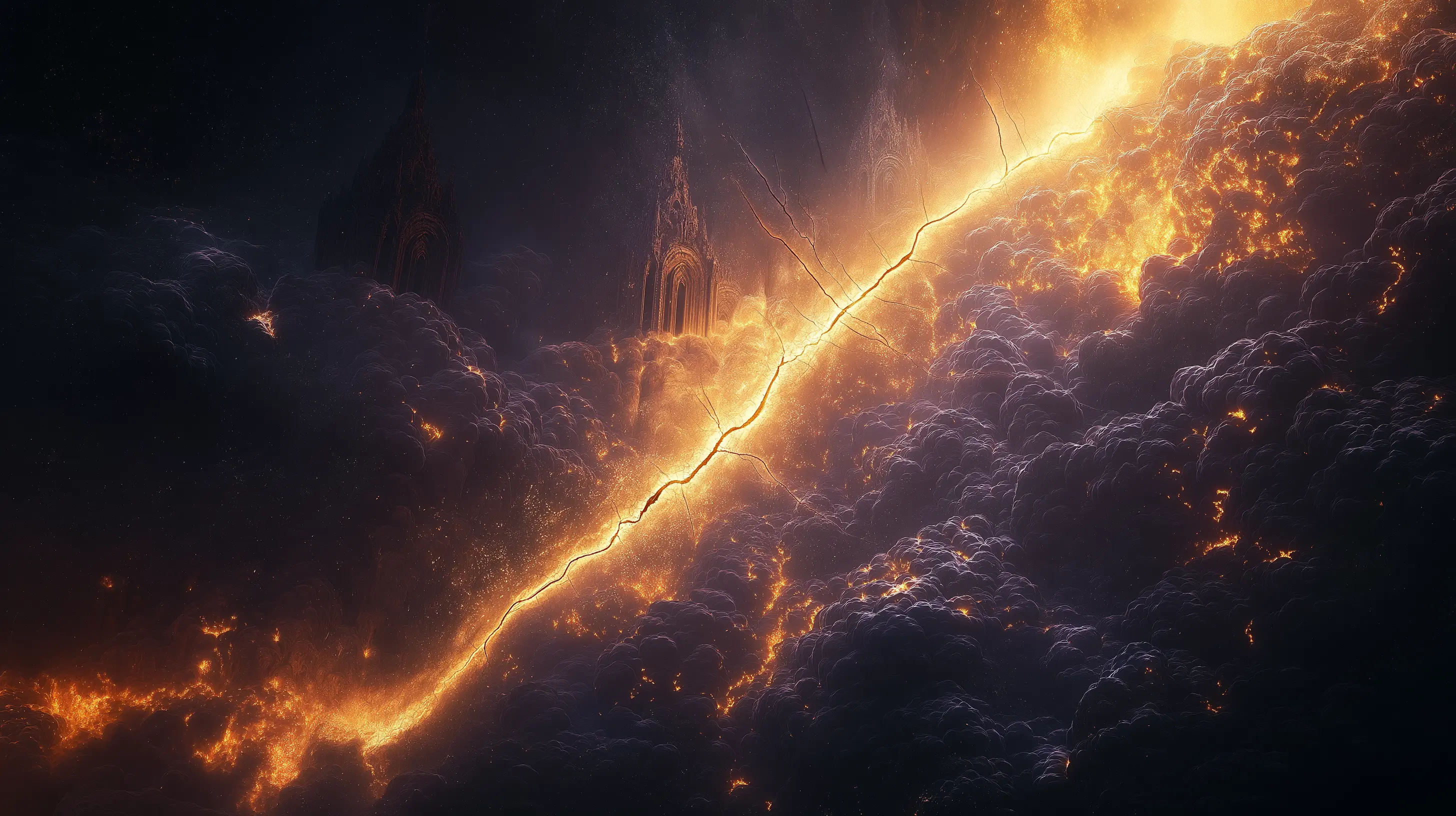
The fracture reached the sky.
If you would keep going, the rest of the cosmos is on Kindle. There is a newsletter, too, for the people who want to be told when there is more.