Enemies-to-lovers, done wrong, is just banter. Two people who are rude to each other for three hundred pages before one of them is injured and the other nurses them back to health and the hostility dissolves into attraction because it was apparently always attraction wearing a disguise. The enemies-to-lovers in that version is a surface texture, not a structure. The enmity is not real. It is a costume the romance is wearing until it gets tired of wearing it.
Done right, enemies-to-lovers is about the cost of having been the kind of people who were enemies to each other, and what it means to cross that distance with the full knowledge of what you did and what was done to you and to choose to cross it anyway.
Kael and Selene are not enemies-to-lovers in the conventional sense. What they are is something the trope does not usually attempt.
They are two people whose love was severed, and who have been maintaining the architecture of distance for forty-three years.
Not enemies. Not rivals. Not strangers. They know each other with the intimacy of a pair who built a Realm together for what amounts to geological time. They know each other’s behavioral patterns, each other’s tells, each other’s ways of moving through damage. Kael knows exactly how Selene overfunctions when she is afraid. Selene knows exactly what it means when Kael starts mapping rooms rather than inhabiting them.
The knowledge between them is not the knowledge of people who dislike each other. It is the knowledge of people who once had no borders between them and who have spent four decades re-establishing borders with architectural precision.
The Sundering Event, the fracture of their bond forty-three years ago, was not caused by hatred. The book’s central mystery is what caused it, and the revelation, when it arrives, reframes everything that came before. What they have built between them in the decades since is not enmity. It is the elaborate structure that two people build when they have to keep living in proximity to someone who was once the entirety of the world and can no longer be that.
The trope gets interesting when you take out the hostility and leave the history.
Hostility is, in some ways, the easy version. Two people who openly dislike each other are clearly in conflict. The reader knows where they stand. The love emerging from that dislike has a certain arithmetic: opposition becomes attraction, the friction generates heat, the heat becomes something else. It is emotionally legible and plot-efficient.
What Kael and Selene have is harder to write and harder to read, and it asks more of the reader.
They are two people in restraint rather than hostility. The care is present and enormous and almost entirely unexpressed. Kael keeps his distance not because he does not want her but because he believes his nature, his Unmaker nature, the nature that was always regarded with caution and handled as a liability, makes him too dangerous to allow himself proximity. His restraint is the shape his love takes when it is trying not to cause damage. The distance between them is not absence of feeling. It is feeling that has learned to hold itself still.
Selene’s restraint is different and in some ways more dangerous. She is not holding herself back from warmth. She is running out of warmth. Forty-three years of sustaining herself without her regeneration source, without the bonded partner the Soul Economy requires for full function, has pushed her into a deficit state. The compassion she built her identity around is fading. Not because she has become cold. Because she has been bleeding for a very long time and has not let herself be held.
This is what the distance between them has done. Not dramatic antagonism. Slow depletion. The kind of damage that does not announce itself.
The question of whether they can choose each other again has to be earned rather than performed.
In the conventional enemies-to-lovers, the earning is mostly about one party apologizing for being rude. In this book, the earning is about moving through the specific, enumerable cost of what happened between them. The Sundering collapsed hundreds of Realms. Other Architect pairs died in the cascade. The love they had was already, once, the most destructive force in the cosmology.
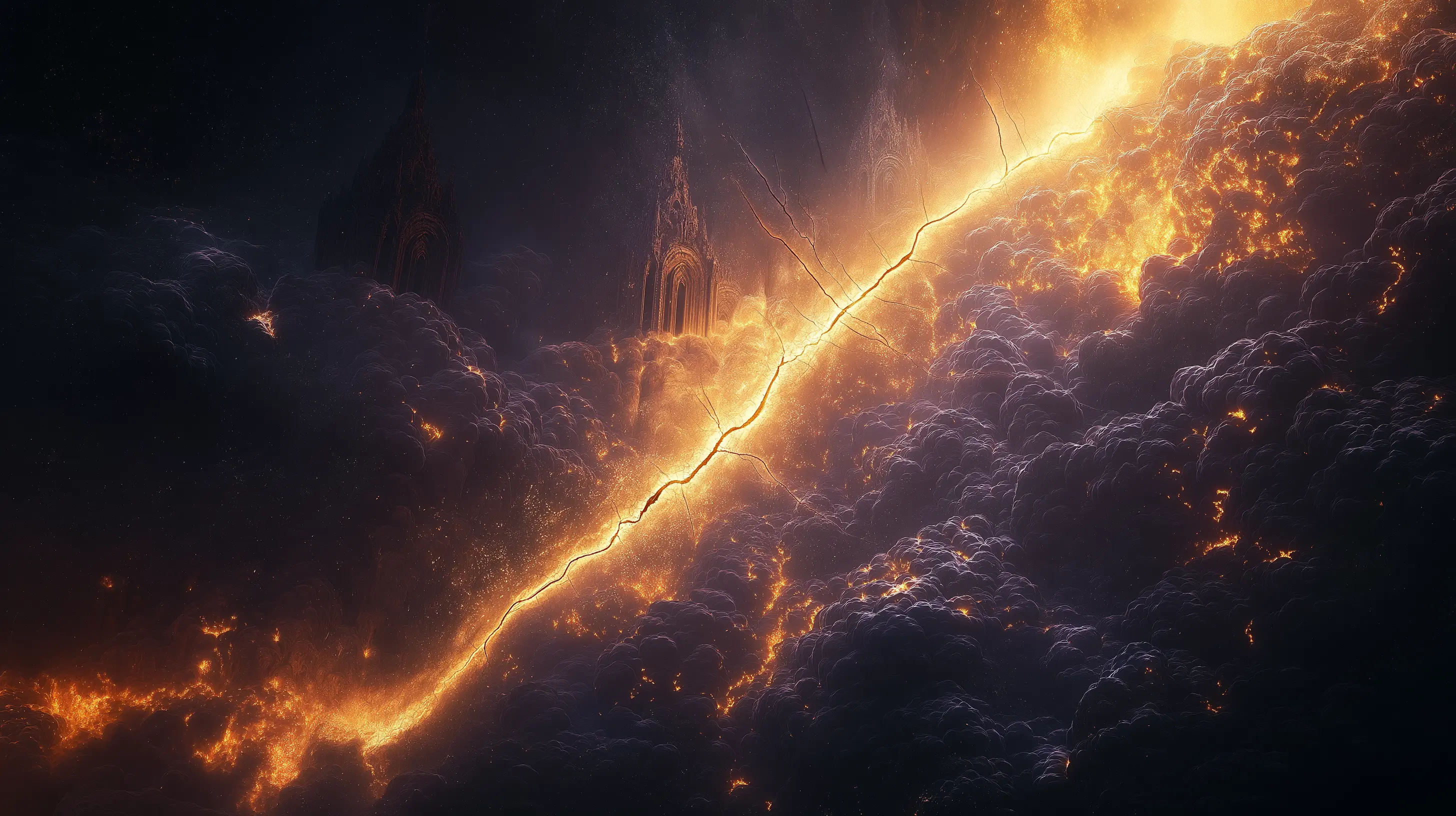
Choosing it again requires knowing that. The romance cannot proceed as if the cost was abstract. The cost was other worlds. The cost is the building they are standing in, the Scar Cathedral generated from crystallized grief and unspent divine energy. The cost is everywhere they look.
What makes it romantasy rather than tragedy is that the love is not just the most destructive force. It is also, as the book’s architecture eventually reveals, the only force capable of dismantling the laws that broke them. Prime Resonance, generated only by Forged Love at its full force, is the physics by which the Glyph Language can be rewritten. The Celestial hierarchy that administered their Sundering, that took their bond and fractured it to protect its own power, is vulnerable only to the thing it tried to destroy.
This is not enemies-to-lovers. This is something older and more specific. Two people who have been carrying the weight of what they were to each other, who understand the cost, who choose each other again not because the cost disappears but because the love is worth what the love requires.
The restraint is not the obstacle to the romance. The restraint is the romance, carried across forty-three years of trying to hold the world steady without the person who made holding it possible.