A magic system without cost is a permission slip. It tells the characters they can do things. What it does not tell them is what doing those things means. The physics are real but the consequences are optional, and a reader can feel that absence the way you can feel a room where someone has removed the weight-bearing walls. Everything is still standing. But you can tell something has been taken out.
The Sacred Laws in The Moon’s Shadow are not a magic system. They are the physics of consequence.
Every act of power in this cosmology burns Soul Weight, a quantifiable mass of divine essence. Soul Weight regenerates slowly during rest and faster in the presence of a bonded Architect partner. This is not a resource management mechanic. It is the physics by which the emotional logic of the book becomes material.
Kael and Selene have been separated for forty-three years, which means they have been regenerating alone for forty-three years. Both of them are running below what they are designed to sustain. The Deficit State, the state an Architect enters when Soul Weight drops below a critical threshold, strips away essential attributes in sequence: memories first, then emotions, then selfhood. Selene’s fading compassion in the novel is not a character flaw emerging. It is a depletion symptom. She is running out of herself.
Kael recognizes the Deficit State because he has been living inside a version of it long enough to have named his symptoms discipline. His careful distance, his clinical precision, his attention without warmth, what he has called restraint is also a portrait of someone who has been bleeding slowly for a very long time. He did not name it because naming it would require acknowledging what it was a symptom of, and that acknowledgment would break something structural in how he has built his self-containment.
When Selene starts to present the same way, he cannot tell her this. He recognizes her, and the recognition is terror, and he does not speak it.
This is a consequence. It is not dramatic. It is accumulated. It is the kind of cost that does not announce itself but shows up in behavior, in what a person stops being able to feel, in the long arithmetic of choosing alone over together until alone is the only fluency you have left.
The Sacred Laws make love itself the most destabilizing force in the cosmos.
Sacred Law I: Makers and Unmakers must never bond beyond function. Sacred Law V: Forged Love, love that rewrites the fabric of a Realm, is forbidden. The official rationale was stability. The actual rationale, which the book reveals in its final acts, is control.
Forged Love generates Prime Resonance, the only force capable of rewriting the Glyph Language at its foundational level. The Glyph Language is the code underneath everything, written before the Architect system existed, programming beneath every law that governs the cosmos. A Forged Love pair could rewrite the fundamental architecture of existence. Including the laws that maintain the Celestial hierarchy’s power.
The beings who authored the Sacred Laws feared what Kael and Selene were. Not because their love destabilized Realms. Because their love, at full force, was the only thing in existence that could render the rule-makers’ rules optional.
This is what makes the prohibition structural rather than decorative. The Sacred Laws are not in place to protect the cosmos. They are in place to protect the people who wrote them. The love that is forbidden is forbidden precisely because it is powerful enough to change everything if the people feeling it choose to.
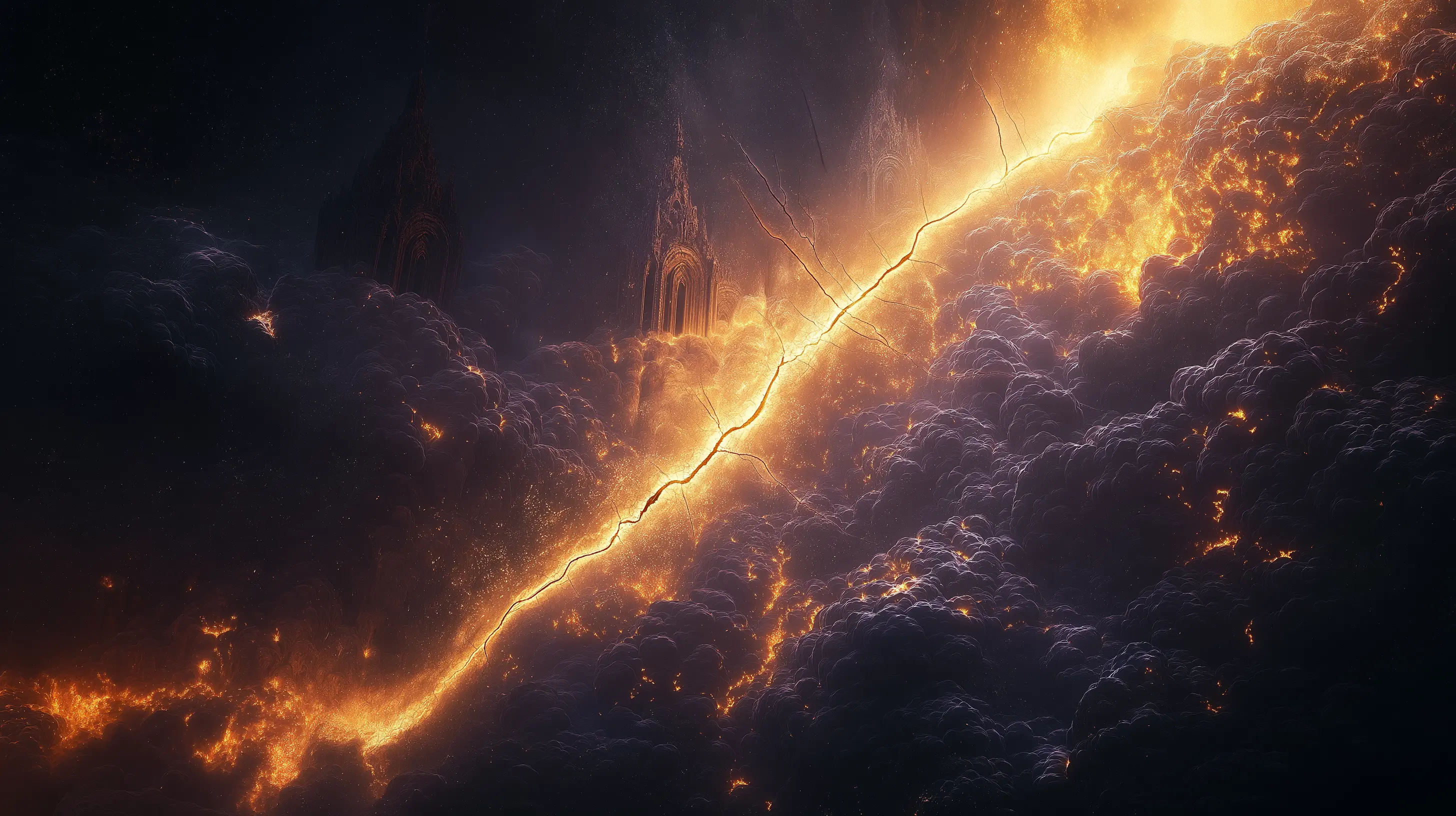
Magic Rot is what happens to divine energy used without purpose, without the balancing intent of Maker and Unmaker acting together. It manifests as corruption of reality: surfaces developing impossible textures, living things looping in behavioral cycles, time stuttering. The only way to address it is for a Maker and Unmaker to perform joint creation simultaneously. You cannot destroy Magic Rot. You can only transmute it.
Which means that to fix what is breaking in the Cathedral, Kael and Selene have to create something together. The healing requires cooperation. The cooperation requires trust. The trust requires moving through forty-three years of unresolved damage, carefully, in the presence of each other, in a building that is made of the damage and will not let them ignore it.
The magic system is not an external challenge. It is a mirror.
The Soul Economy as a material physics for grief asks: what does it cost to sustain yourself on loss? What does it do to a person, over time, if they burn without restoration? What does it look like when someone has been running a deficit long enough that the deficit becomes their baseline, their normal, the water they move through without thinking of as water?
A cosmology without cost is a cosmology that does not matter, because nothing in it can be exhausted. Nothing in it can be lost for real. The reader knows, at the cellular level, that the rules can be stepped around.
The Sacred Laws cannot be stepped around. They were already violated. The violation already ended hundreds of worlds. The cost is not hypothetical. The cost was the Sundering, and the Sundering is the wound the entire book is sitting inside of.
That is what magic with real consequence looks like. Not a tax paid in points. A debt that has already been called in, that is still being paid, that the people who owe it have to decide whether they will accrue again.